Multivariate Multicycle Codes

Stefan Krastanov
University of Massachusetts Amherst

UMass Team

QEC
modular fault tolerant architectures
Quantum Networks
control and applications
Scientific Software
open-source tools and community building

Open Source

QuantumClifford.jl
algebra of stabilizer states & qECC
QuantumSavory.jl
network simulation tools (NSF CQN and NSF NQVL AspenNet)

Summer School on Numerical Methods

QNumerics Summer School

Multivariate Multicycle Codes

Work done by Feroz Mian with help from Owen Gwilliam and me (Stefan Krastanov)

Good Classical Codes

rate
\(k/n\not\to0\)
distance
\(d/n\not\to0\)
decoder
efficient prediction of correction (i.e. an approximate MLE)
And a "bit" more, e.g. achieving channel capacity.

How They Are Made

Almost as simple as just picking a random sparse binary matrix.
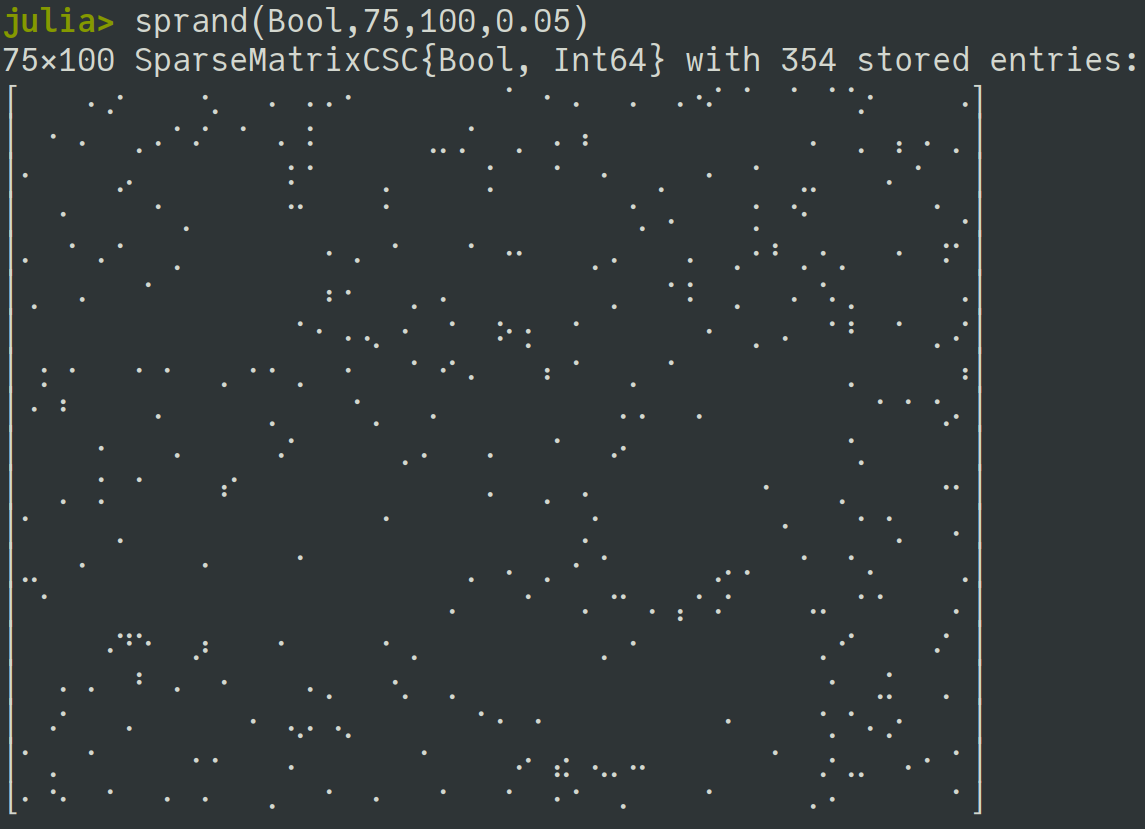
random binary matrix

Quantum Codes Need Two Classical Codes

\[ P_X P_Z^{\!\top}=0 \]

Difficult to sample Quantum Codes at random

sample good \(P_Z\)
randomly choosen, large \(k,d\)
find compatible \(P_X\)
\(P_XP_Z^{\!\top}=0\)

\(P_X\) will probably be a bad code (dense, high weight)

Better Representations

expander graphs
start with a good Tanner graph
chain complexes
pick a structure that encodes \(P_XP_Z^{\!\top}=0\) "for free"

Expander Graph Codes

  1. Panteleev, Kalachev
    Asymptotically Good Quantum and Locally Testable Classical LDPC Codes
  2. Dinur et al.
    Good Quantum LDPC Codes with Linear Time Decoders
  3. Gu et al.
    An efficient decoder for a linear distance quantum LDPC code

Chain Complex Representation of Codes

\(C_0 \xleftarrow{\partial_1} C_1 \xleftarrow{\partial_2} C_2\)
\[ \partial_i \partial_{i+1}=0 \]

Homological Algebra

\[ \text{boundaries have no boundary} \]

Vector Calculus (Co)chain Complex

scalar fields
\(\xleftarrow{\partial_1=\operatorname{div}}\)
axial vector fields
\(\xleftarrow{\partial_2=\operatorname{curl}}\)
vector fields
\(\xleftarrow{\partial_3=\operatorname{grad}}\)
scalar fields
\[ \partial_2\partial_3=\operatorname{curl}\operatorname{grad}=0, \qquad \partial_1\partial_2=\operatorname{div}\operatorname{curl}=0 \]

Parity Checks Are Boundaries

\[ \partial(\text{error})=\text{syndrome} \]

A Quantum Code

\(C_0\)X checks
\(\xleftarrow{\partial_1}\)
\(C_1\)qubits
\(\xleftarrow{\partial_2}\)
\(C_2\)Z checks
\[ P_X=\partial_1,\qquad P_Z=\partial_2^{\!\top} \]

Divergence of Curl

\[ \partial_1\partial_2=0 \qquad\Longleftrightarrow\qquad P_XP_Z^{\!\top}=0 \]

Really Good Quantum Codes

rate
\(k/n\not\to0\)
distance
\(d/n\not\to0\)
decoder
cheap approximate MLE
low weight
simpler smaller circuits
single-shot
dealing with measurement noise

Metachecks

\[ M_Zs_Z=0,\qquad M_Xs_X=0 \]

Complete Single-Shot Structure

\(C_0\)X metachecks
\(\xleftarrow{\partial_1}\)
\(C_1\)X checks
\(\xleftarrow{\partial_2}\)
\(C_2\)qubits
\(\xleftarrow{\partial_3}\)
\(C_3\)Z checks
\(\xleftarrow{\partial_4}\)
\(C_4\)Z metachecks

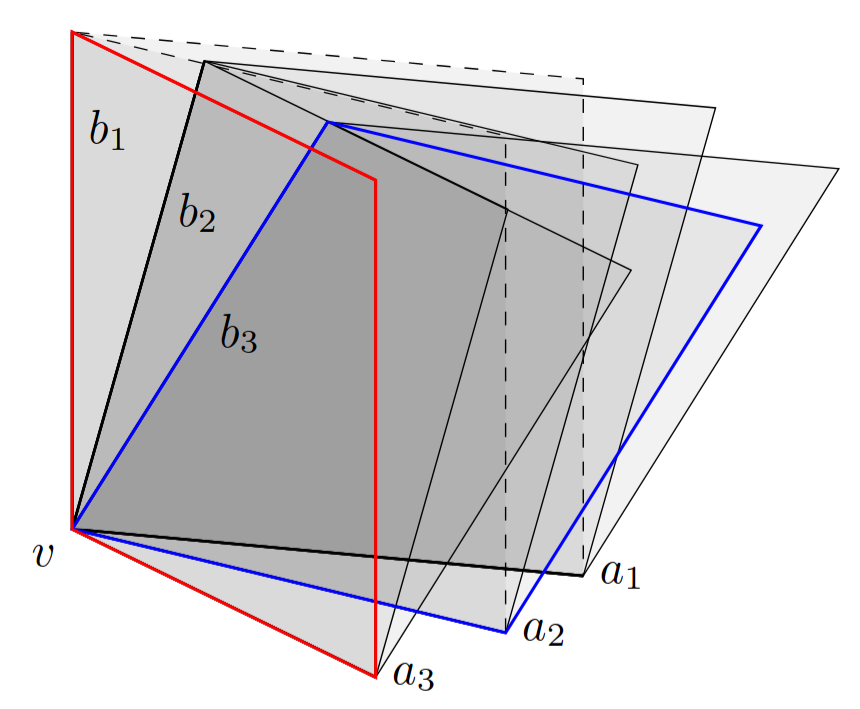
Multivariate Multicycle Construction

pick small binary maps
\(F,G,H,I\in S\) at random
Koszul complex
turn any set of small maps into a chain complex
candidate codes
extract \(P_X,P_Z\) and metachecks

Pick Local Checks at random

\[ F,\ G,\ H,\ I \in S \]
\[ S = \mathbb{F}_2[w,x,y,z]/ \langle w^\ell-1,\ x^m-1,\ y^p-1,\ z^r-1\rangle \]

Polynomial \(\to\) Circulant Matrix

\[ F(w,x,y,z)\ \mapsto\ C_F \]

Koszul Complex

\[ K_\bullet([F,G,H,I];S) \]

Boundary Maps

\[ \partial_4=\begin{bmatrix}F&G&H&I\end{bmatrix} \] \[ \partial_3= \begin{bmatrix} G&H&I&0&0&0\\ F&0&0&H&I&0\\ 0&F&0&G&0&I\\ 0&0&F&0&G&H \end{bmatrix} \qquad \partial_2= \begin{bmatrix} H&I&0&0\\ G&0&I&0\\ 0&G&H&0\\ F&0&0&I\\ 0&F&0&H\\ 0&0&F&G \end{bmatrix} \] \[ \partial_1=\begin{bmatrix}I\\H\\G\\F\end{bmatrix} \]

Extracting the Checks and Metachecks

\[ P_Z=\partial_3,\quad P_X=\partial_2^{\!\top},\quad \]
\[ M_Z=\partial_4,\quad M_X=\partial_1^{\!\top} \]

Consistency for Free

\[ \partial_4\partial_3=0,\qquad \partial_3\partial_2=0,\qquad \partial_2\partial_1=0 \] \[ M_ZP_Z=0,\qquad P_ZP_X^{\!\top}=0,\qquad M_XP_X=0 \]

One Instance

\[ \begin{aligned} F&=(1+x)(1+yz) & G&=(1+y)(1+zw)\\ H&=(1+z)(1+wx) & I&=(1+w)(1+xy) \end{aligned} \] \[ [[648,60,(9,9)]] \]

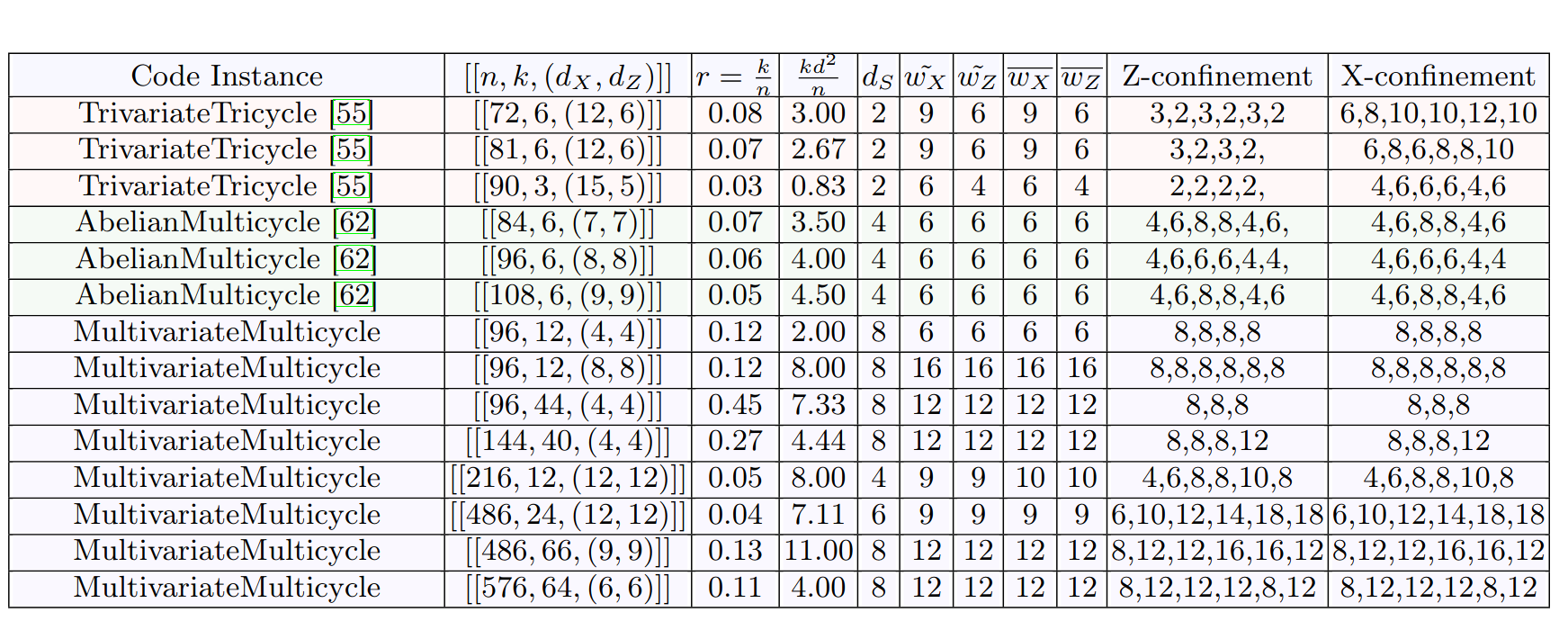
Confinement?

A.k.a. are the metachecks any good

\[ \min_{\operatorname{wt}(e)=w}\operatorname{wt}(Pe) \]
For a given error weight, what is the smallest stabilizer weight?

Record Profiles

Table of codes

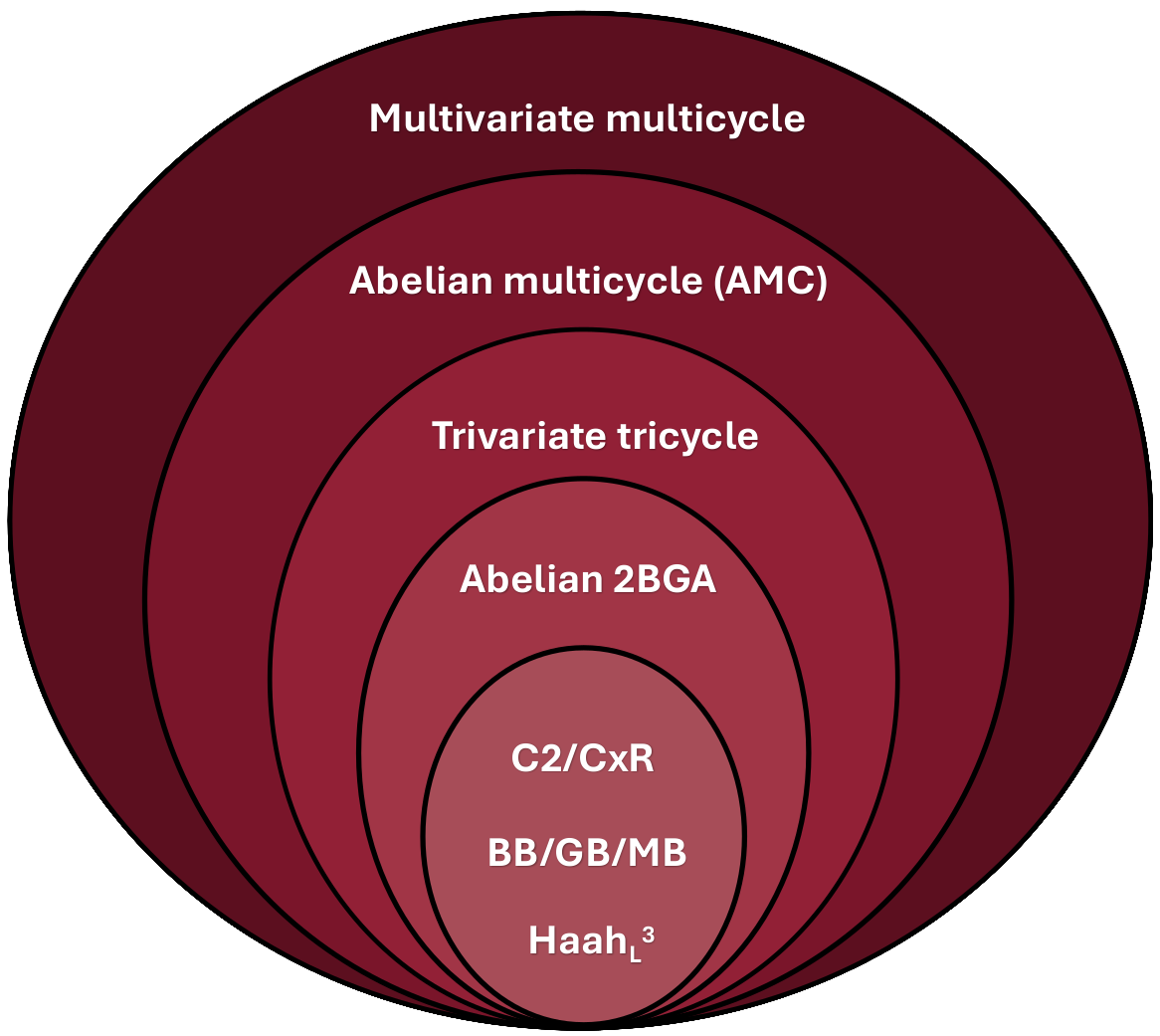
Great Expressivity

Special cases of MM codes: Abelian multicycle, trivariate tricycle, two-block group algebra, cyclic hypergraph product, bivariate bicycle, multivariate bicycle, generalized bicycle, Haah's cubic, and more.

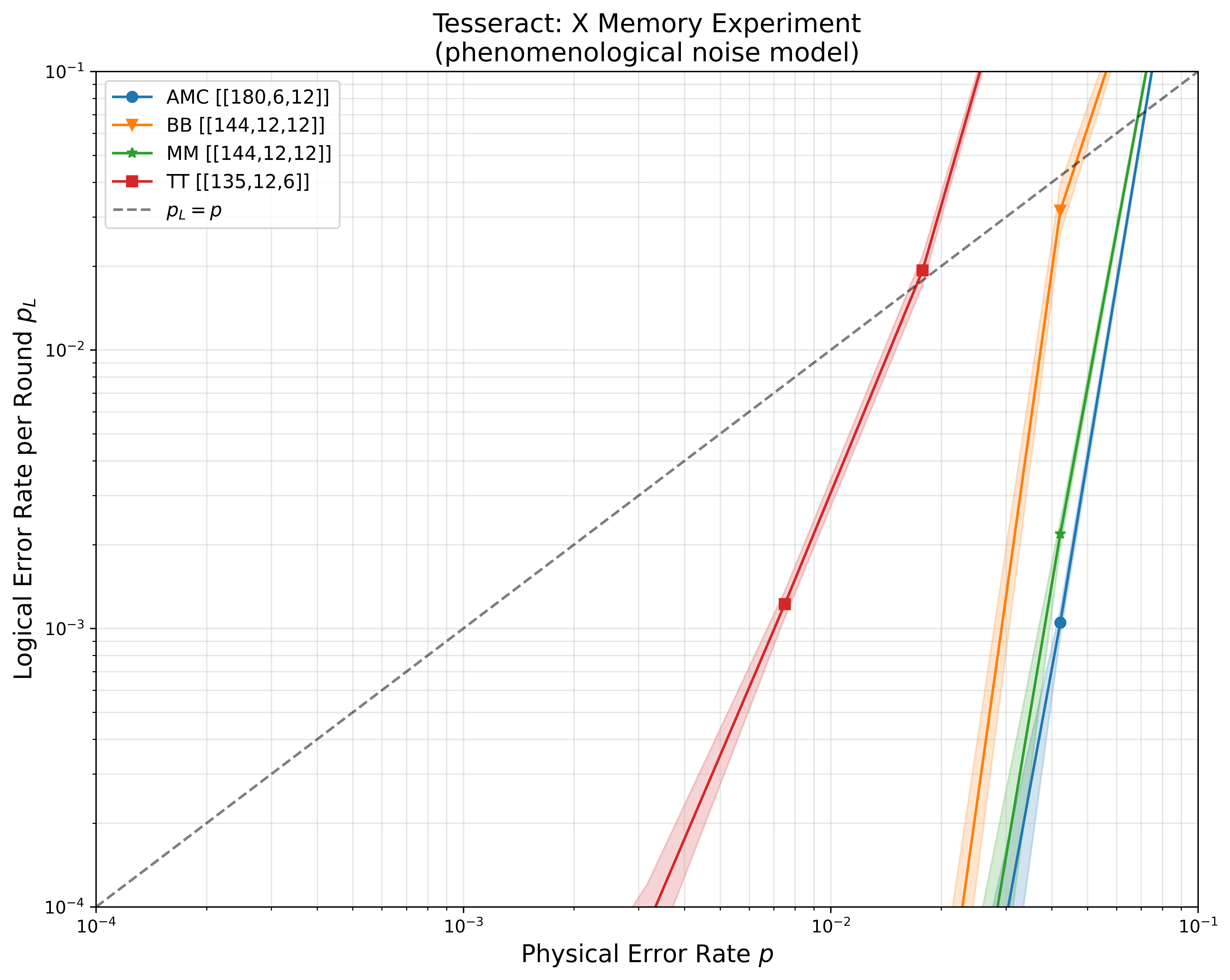
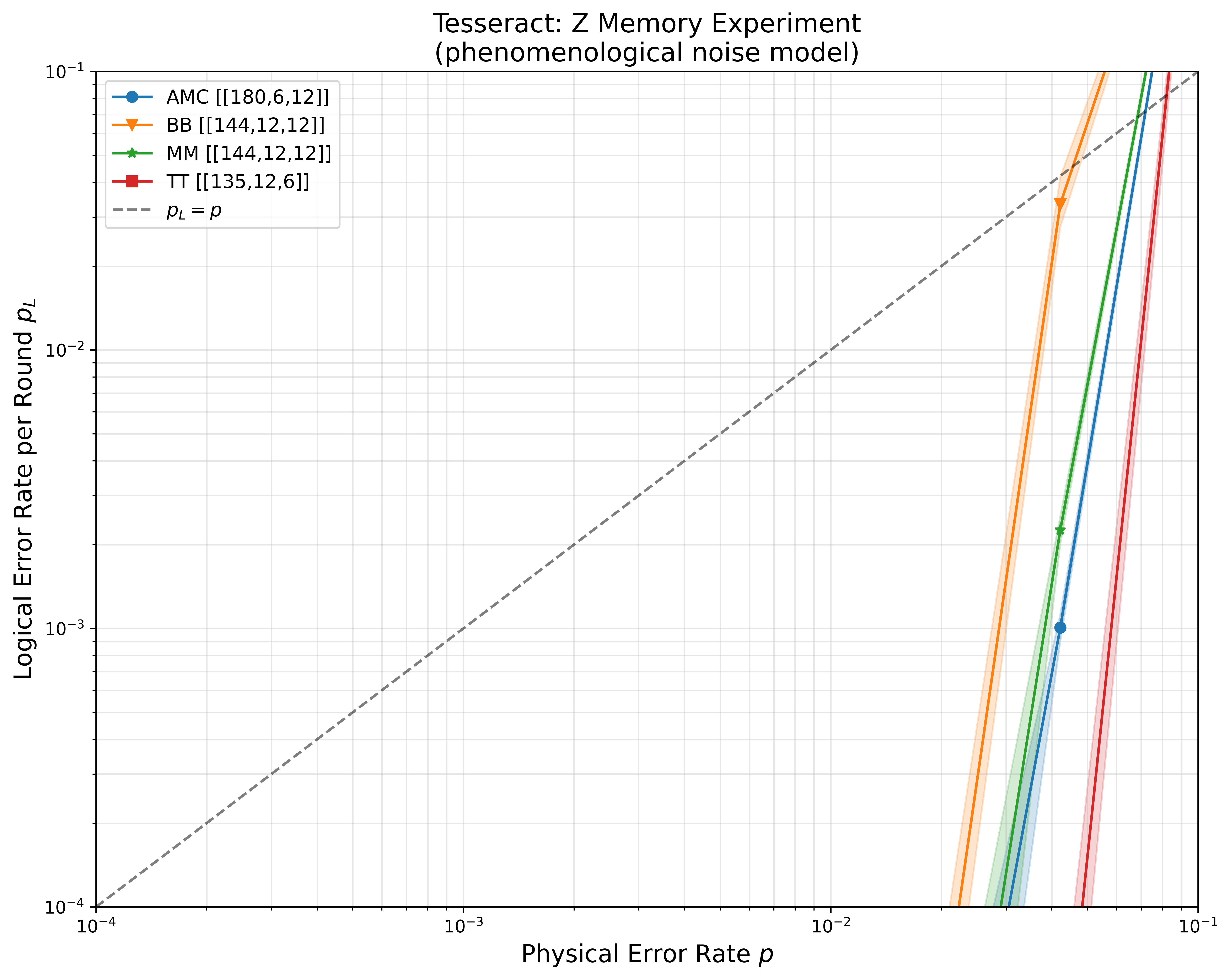
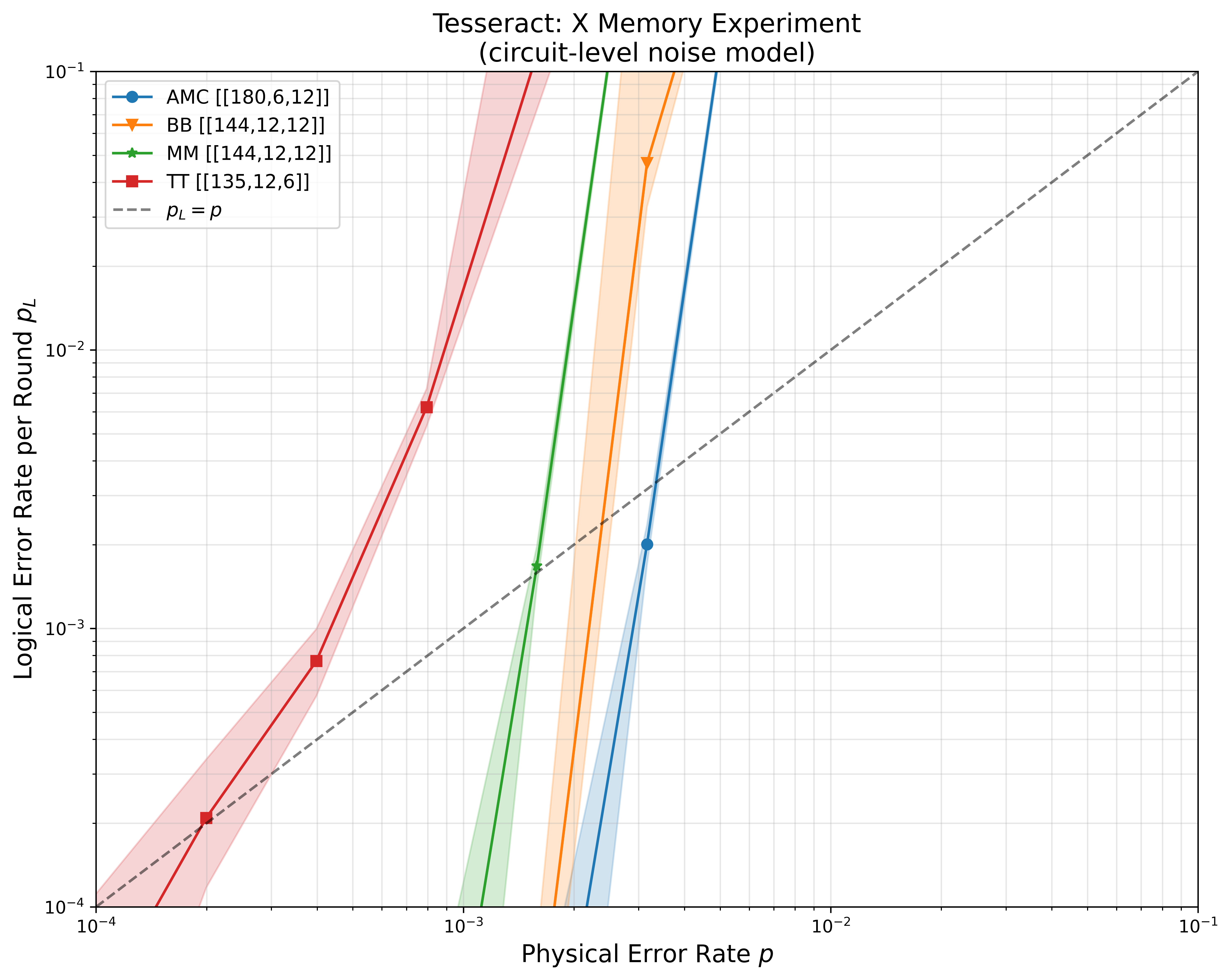
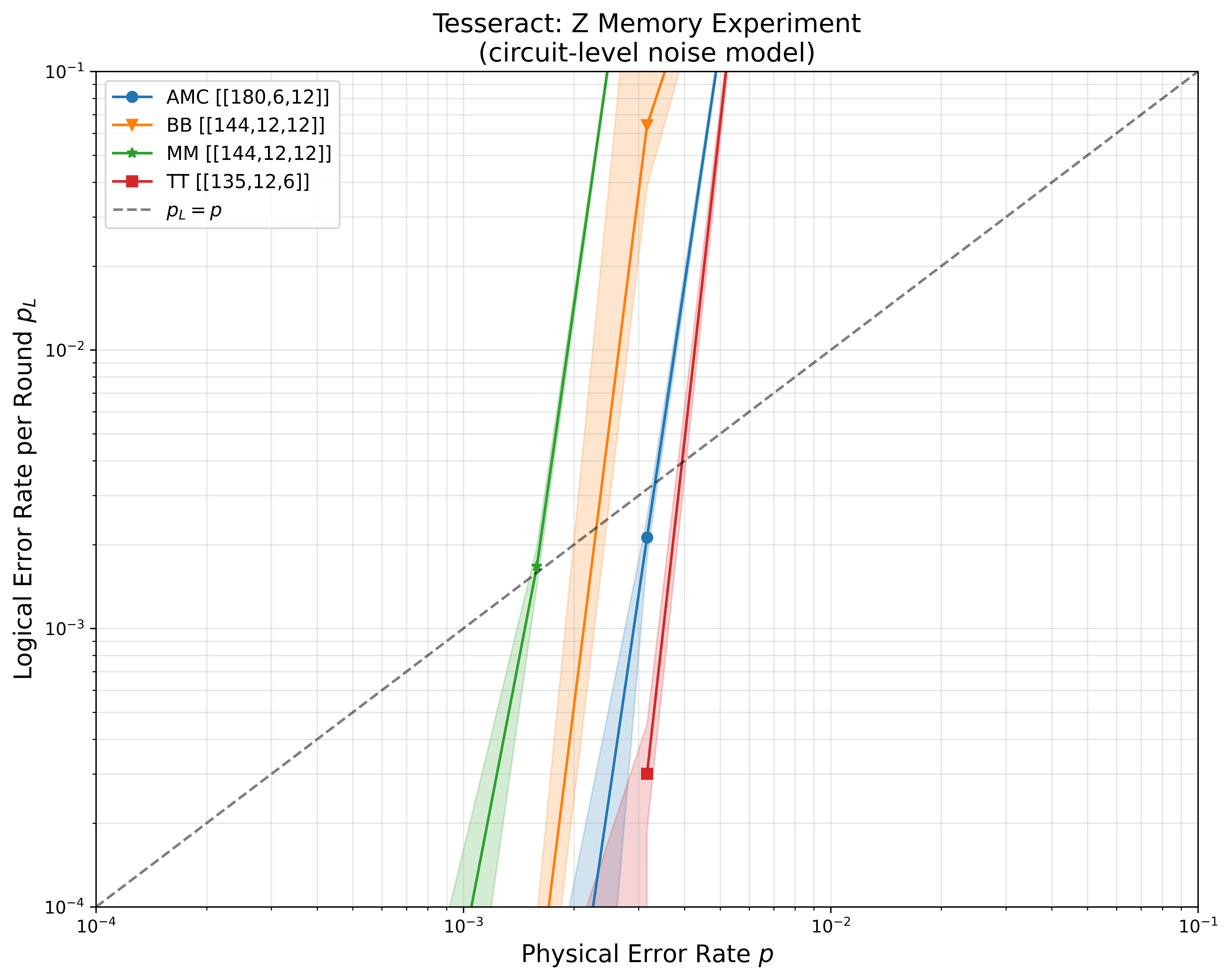
Simulation Results
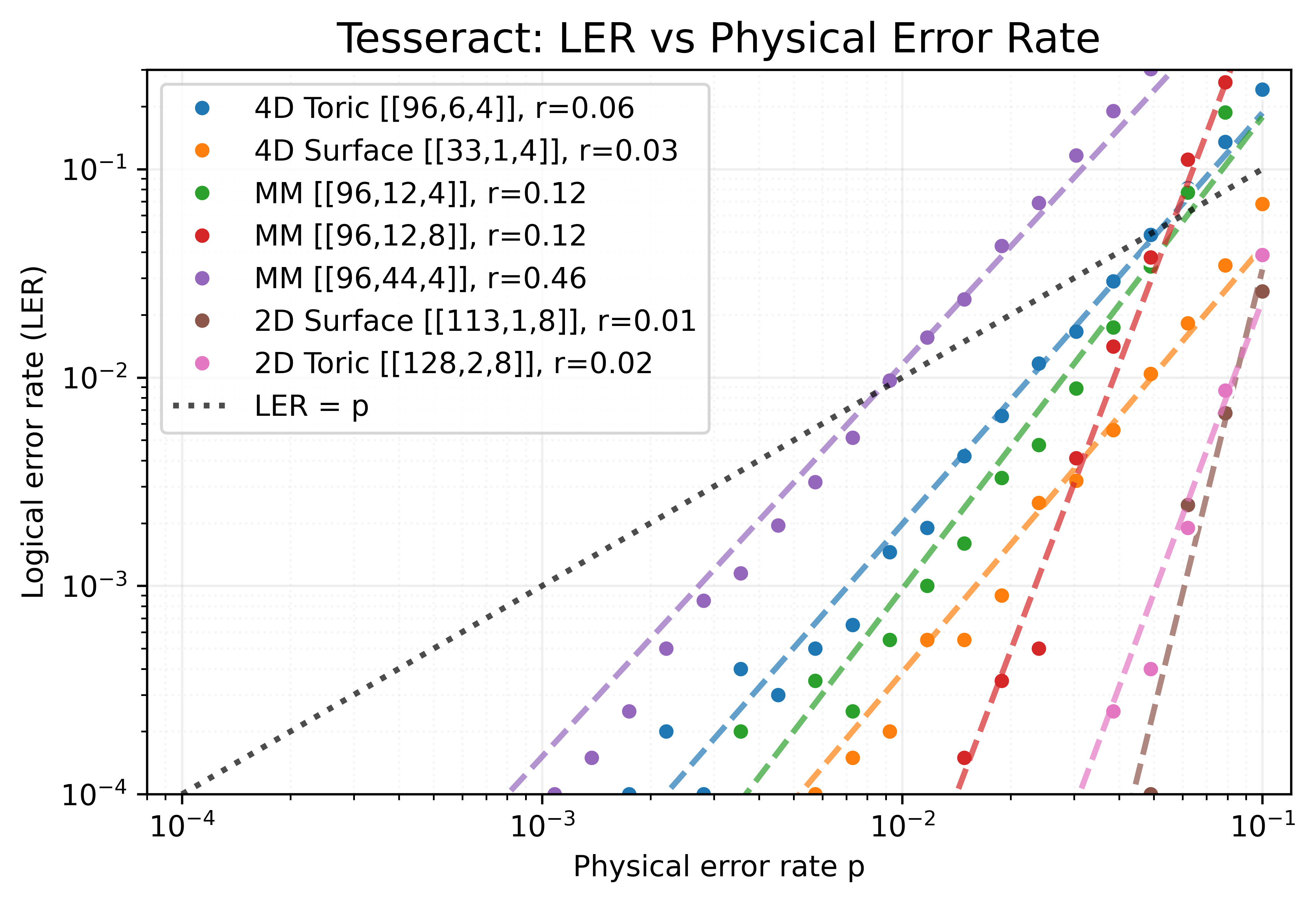
Tesseract decoder logical error rate plot

Phenomenological Noise

Phenomenological X-basis memory plot
Phenomenological Z-basis memory plot

Circuit-Level Noise

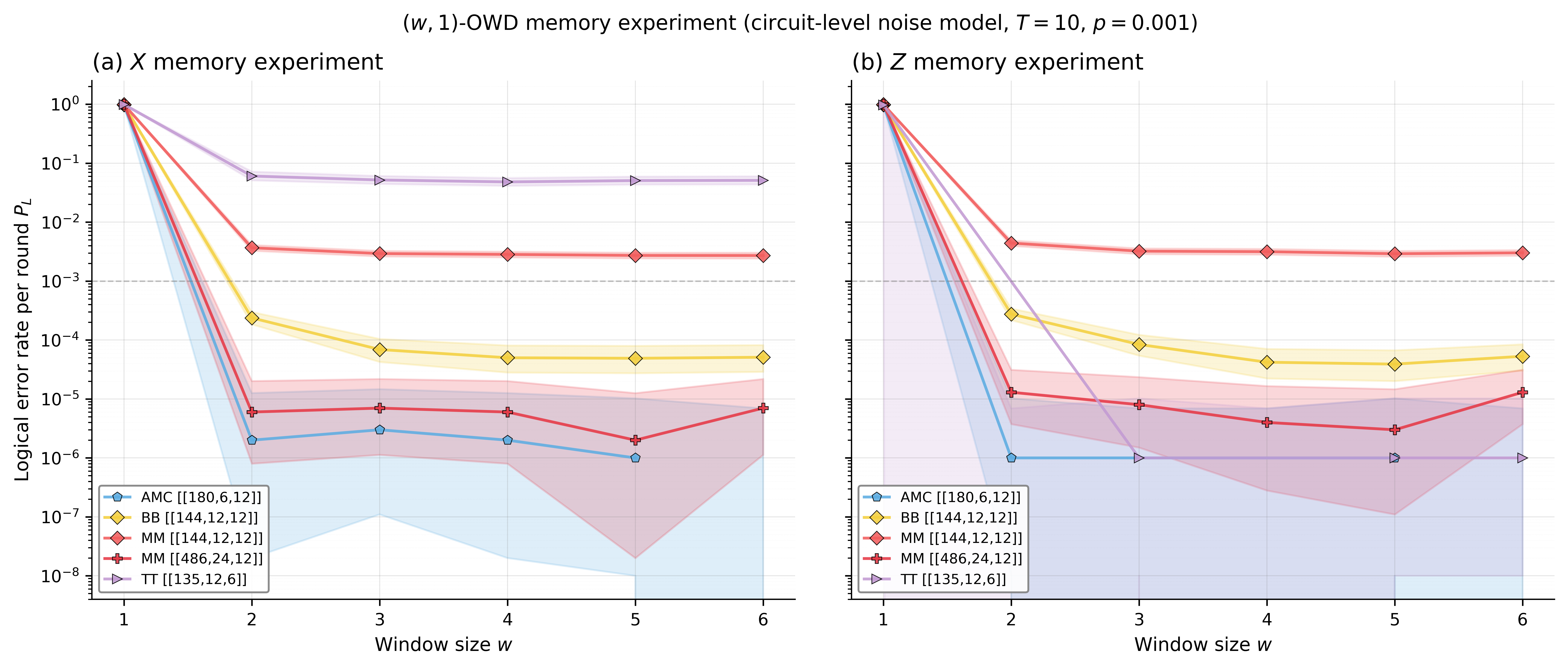
Circuit-level X-basis memory plot
Circuit-level Z-basis memory plot

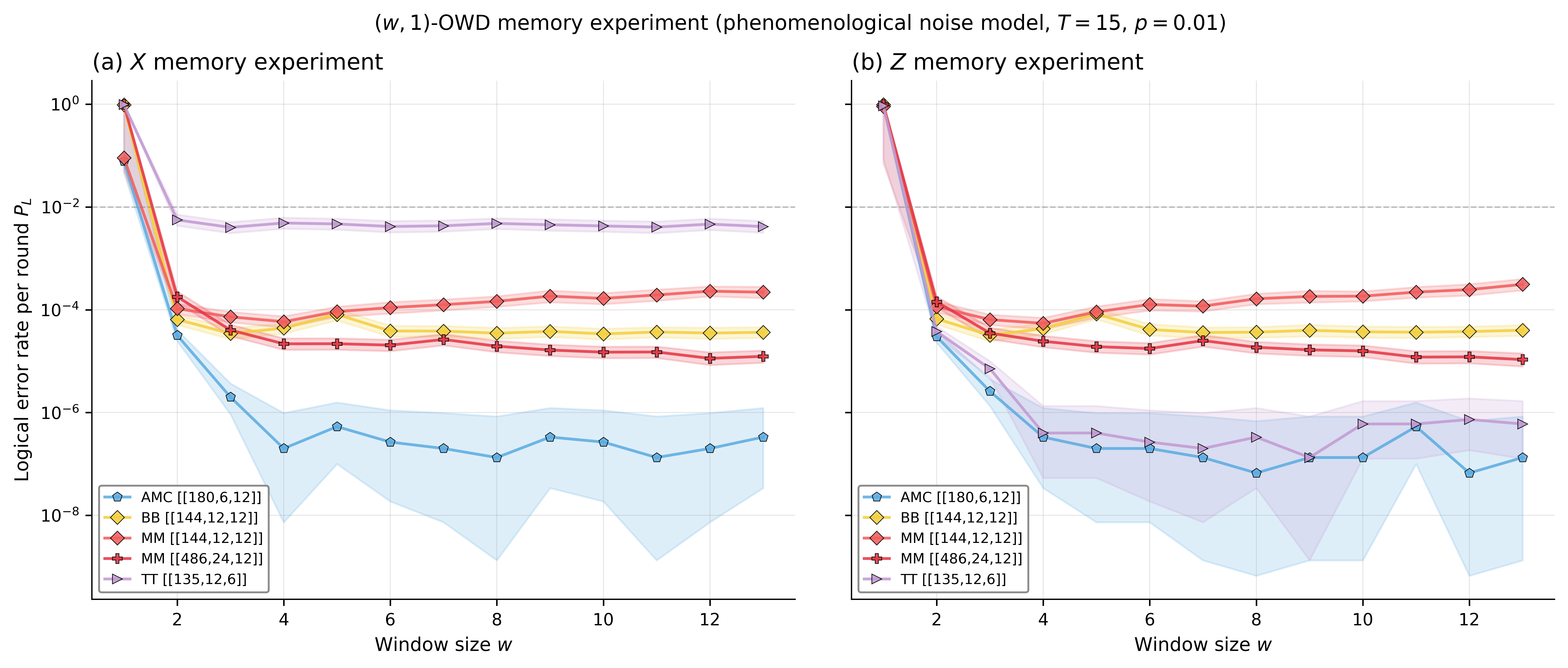
Overlapping Windows

Phenomenological overlapping-window plateau plot

Circuit Plateau

Circuit-level overlapping-window plateau plot

Takeaway

compact representation
just a list of small polynomials
natural representation
random small polynomials gives good codes
confinement
record-breaking single-shot properties

QuantumClifford.jl

Summary

Multivariate Multicycle Codes

arxiv:2601.18879

elegant compact general code representation

complete single-shot structure

We are hiring
(remote worldwide):
software engineering
quantum science

Message at skrastanov@umass.edu

QNumerics summer school at
qnumerics.org

10k$ in code bounties at
github.com/QuantumSavory

Options for larger dev grants as well!

Consider gradschool or postdoc
at UMass Amherst:

UMass Amherst library

Design of quantum hardware.

Working on practical LDPC ECC.

Creating new tools for the entire community.